
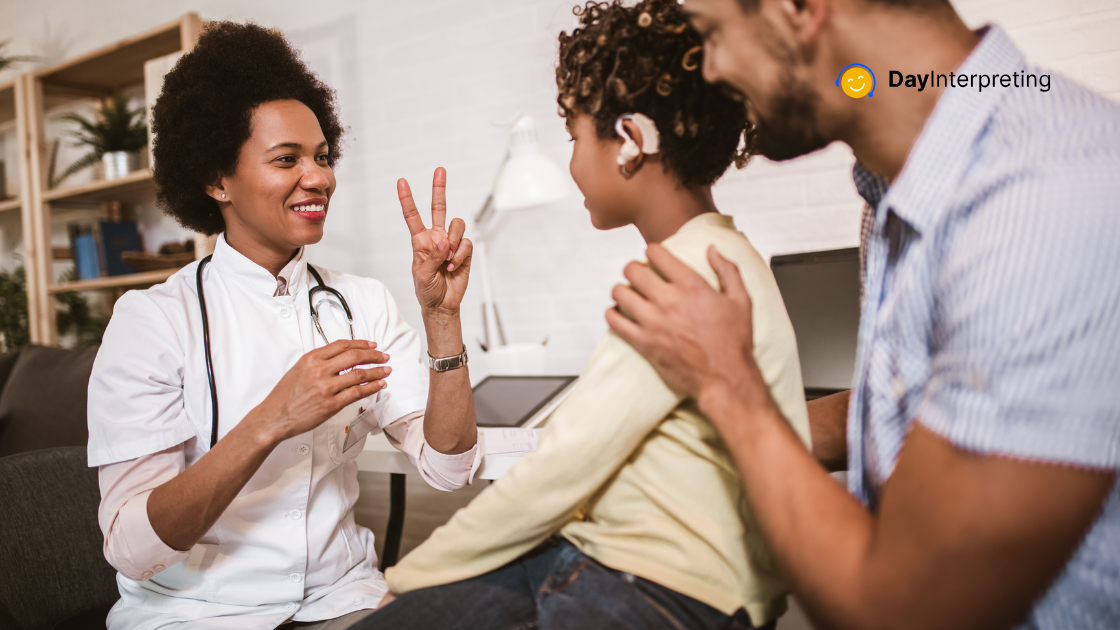
In a hospital, every second counts. But what happens when the patient and the doctor don’t speak the same language?
At Day Translations, we see this scenario play out daily. While technology has come a long way, we’ve learned through years of partnership with healthcare providers that a “good enough” translation can be a dangerous gamble. In a clinical setting, an interpreter isn’t just a person who speaks two languages; they are a critical component of the diagnostic team.
When communication breaks down in a hospital, it isn’t just a misunderstanding—it’s a patient safety crisis. Here is how professional interpreting moves the needle from “lost in translation” to “life-saving care.”

1. Accuracy Prevails Where “Ad-Hoc” Fails
Medical terminology is a language of its own. A well-meaning relative might confuse “palpitations” with “heart attack” or “nausea” with “dizziness.”
In a clinical setting, mistranslation is a medical error. A professional interpreter understands the nuances of:
-
Dosage Instructions: Ensuring a patient doesn’t take 10mg instead of 1.0mg.
-
Symptom Precision: Distinguishing between sharp, stabbing pain and a dull ache—critical for diagnosing anything from appendicitis to an aneurysm.
-
Allergy Warnings: Relaying vital contraindications that a non-professional might overlook.
Case Study: When a Single Word Changed Everything
To understand the stakes, we only have to look at the real-world implications of “ad-hoc” interpreting.
In a well-documented medical case, a Spanish-speaking patient was brought to the ER stating he was “intoxicado.” To a layperson or a basic translation tool, this sounds like “intoxicated” (alcohol or drugs). The hospital treated him for a drug overdose for 36 hours.
However, in many Spanish dialects, “intoxicado” actually means “nauseated” or “food poisoning.” Because a professional interpreter wasn’t used initially, the medical team missed the real culprit: a brain hemorrhage. By the time the error was caught, the patient was quadriplegic.
The Lesson: A professional medical interpreter knows the “false cognates” and regional nuances that a family member or a machine will miss. This level of precision is exactly what we provide through our specialized healthcare translation and interpreting services, ensuring that “intoxicado” never leads to a life-altering misdiagnosis.
2. The Danger of “Family Interpreting”
It is tempting to ask a patient’s bilingual child or spouse to help. However, this creates two major risks:
-
Emotional Filtering: Family members often “sugarcoat” bad news or omit “embarrassing” symptoms (like bowel habits or mental health struggles) to protect the patient’s feelings.
-
The Burden of Responsibility: Putting a child in a position to translate a terminal diagnosis is a psychological weight no family member should carry.
3. Cultural Brokerage: More Than Just Words
A good interpreter doesn’t just translate language; they translate culture. Certain cultures express pain differently or have specific beliefs regarding blood transfusions, end-of-life care, or gender-concordant providers. An interpreter acts as a cultural broker, helping the doctor understand why a patient might be hesitant to follow a treatment plan, which leads to better compliance and faster recovery.
How a Great Interpreter Saves Lives: A Quick Look
| Feature | Family/App Translation | Professional Medical Interpreter |
| Terminology | Often guessed or simplified | 100% accurate medical coding |
| Confidentiality | High risk of privacy leaks | Strict HIPAA compliance |
| Objectivity | Emotionally biased | Neutral and professional |
| Legal Safety | High risk of malpractice | Minimizes hospital liability |

4. Legal and Ethical Mandates
In many regions, providing “meaningful access” to language services isn’t just a courtesy—it’s the law. Under Section 1557 of the Affordable Care Act (ACA), hospitals receiving federal funding must provide qualified interpreters. Using professional services protects the hospital from massive malpractice suits and ensures every patient receives the same standard of care, regardless of their native tongue.
Summary: The Human Bridge
At the end of the day, a medical interpreter provides dignity. When a patient can speak and be heard, their anxiety drops, their trust in the medical team grows, and the diagnostic process becomes a precision tool rather than a guessing game.






0 Comments